
Appearance
How Marketers Can Use AI-Powered Newsletters to Turn Scattered Content Into an Owned Audience
Publishing useful content consistently is one of the hardest parts of marketing, and it is exactly the problem AI-powered newsletters are designed to solve. Not because there is nothing to say, but because assembling, summarizing, and distributing it week after week takes more time than most teams have.
AI-powered newsletters change that. Not by writing everything for you, but by handling the parts that eat your time: monitoring sources, summarizing articles, organizing a draft, suggesting subject lines. Collecting links is boring. Writing the first rough summary is boring. Deciding what matters, adding your own perspective, and understanding your audience are not. That is the real job. The system handles the mechanical parts so you can focus on the ones that actually create value.
That shift has two real benefits for marketers.
The first is time. Instead of building each newsletter from scratch, you build a system that runs it. The marketer's job moves from execution to oversight, which is more scalable and more interesting.
The second is audience ownership. Social media reach is borrowed. Algorithm changes, platform rules, and shifting feeds can cut your visibility overnight. Email is different. Every subscriber is a direct channel you control. An automated newsletter gives you a reason to show up in that channel consistently, without burning out your team or your budget. If you are still building that list, this guide covers how to do it right.
Done well, it is also a positioning strategy. The company that consistently surfaces the most useful signal in a noisy space becomes the trusted filter for its audience. That is a durable competitive advantage.
The real problem is not lack of content
RSS feeds. YouTube videos. Blog posts. Social media updates. Product announcements. Industry reports. Podcast episodes. Webinars.
There is useful content everywhere, but the problem is that it is scattered everywhere too.
Your audience does not have time to follow ten blogs, five YouTube channels, three newsletters, a few LinkedIn creators, and every company in your market.
Most people are already drowning in content, and they do not need more noise. They need someone to filter things for them.
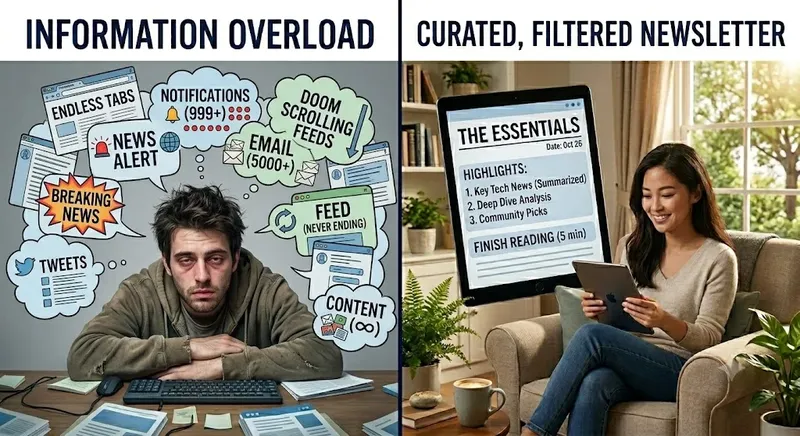
Most companies do not have a content problem. Actually, the opposite is true. There is too much content.
Some of this content comes from your own company. But most of it does not, and that is the important part.
If you only build a newsletter from your own blog posts and your own videos, that can still be useful. It helps you distribute your own content better.
But it is also limited. Your company is just one source, but the whole internet is much bigger than that.
There are experts, publications, creators, partners, communities, competitors, analysts, and customers publishing useful things all the time. Your audience probably does not have time to follow all of them.
So the opportunity is not only to repurpose your own content.
The bigger opportunity is to become the filter.
You can use third-party sources as raw material and turn them into a useful, branded newsletter for your audience.
That could mean collecting:
- articles from trusted industry blogs
- videos from selected YouTube channels
- updates from product and platform blogs
- reports from research companies
- podcast episodes
- social media posts and discussions
- your own company updates
- customer stories and examples
The sources are all there. The bottleneck is the work it takes to turn them into a useful newsletter every week.
What AI can actually help with
AI is useful in this workflow because preparing a newsletter manually can be annoying.
You have to check sources, open links, skim articles, review videos, write summaries, organize sections, create a subject line, format everything, and then finally send the email.
If you do this every week, it becomes a lot.
AI can help with the repetitive parts.
For example, it can:
- summarize long articles
- turn YouTube video descriptions into short blurbs
- group content by topic
- detect similar stories
- rewrite summaries in your brand voice
- create section introductions
- suggest subject lines
- personalize content for different segments
- prepare a first draft of the newsletter
The important thing is that AI is helping with preparation, not replacing editorial judgment.
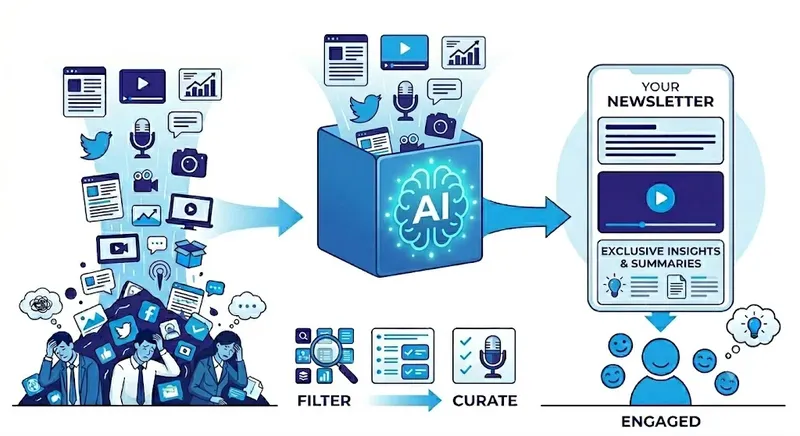
It can do the heavy lifting.
You still decide what deserves attention.
How much should you automate your newsletter?
There is no single correct answer.
Different newsletters need different levels of oversight.
For many companies, the best starting point is a human-in-the-loop workflow:
- The system collects content from selected sources.
- AI prepares summaries and organizes the draft.
- A marketer reviews, edits, and approves the issue.
- The newsletter is sent.
This approach saves time while keeping quality under control.
As the process becomes more predictable, you can automate more of it.
For example, you might define rules such as:
- only use trusted sources
- ignore duplicate stories
- include no more than five links
- always include the original source
- summarize, but do not copy full articles
- group items by topic
- use a consistent tone
- send only when there is enough high-quality content
- ask for approval if confidence is low
With clear rules, some newsletters can become largely autonomous.
The marketer is no longer manually assembling every issue.
Instead, the marketer is designing and improving the system that produces it.
That is where automation becomes truly scalable. BlueFox Email's automations are built to support exactly this kind of workflow.
RSS is a great starting point
RSS is not trendy. That is partly why it is useful.
It is simple, open, and predictable. Many blogs, publications, podcasts, and news sites still provide RSS feeds. You can pull new items from those feeds and use them as the raw material for a newsletter.
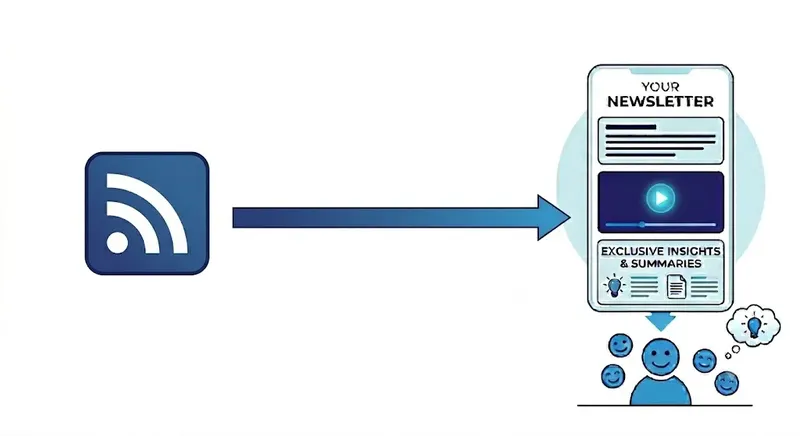
For an automated newsletter, RSS is probably the easiest place to start. We previously published a tutorial about how you can turn a single RSS into a newsletter, but you can do much more than that. That article explains a rather simple process, illustrated by the image below.
You can collect many things from third-party RSS feeds as well:
- articles and blog posts
- podcast episodes
- images, depending on the feed
- descriptions and summaries
For marketers, this is useful because you can build a newsletter around trusted sources. A few industry publications, platform blogs, thought leaders, and your own company blog can be combined into a single curated digest.
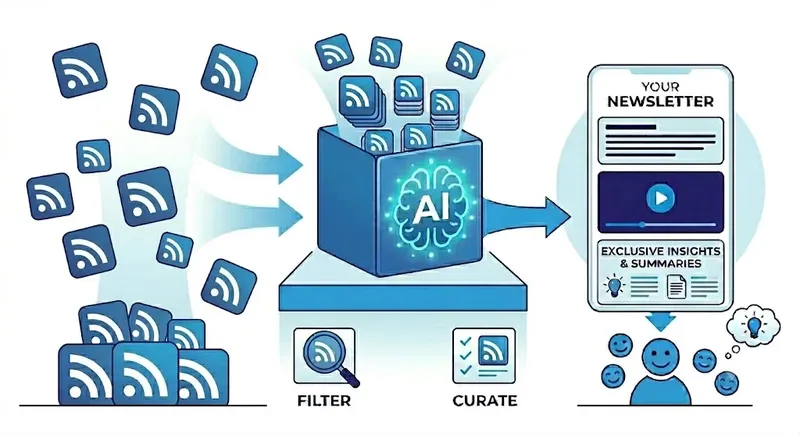
Not everything needs to be written from scratch.
Sometimes the value is in finding the right things and explaining why they matter.
YouTube can make the newsletter richer
YouTube is also a strong content source. A company can include its own videos, such as tutorials, product demos, webinars, interviews, or customer stories, or it can curate useful videos from other trusted channels.
But again, the important thing is context.
Do not just write:
New video: “Email Marketing Tips for 2026”
That is not very useful.
Write something like:
This video is worth watching if you are trying to improve your onboarding emails. It shows three simple ways to reduce drop-off after signup.
That small explanation makes a big difference.
AI can help write these summaries, and it can often generate them automatically from video subtitles or transcripts without you having to write the summary yourself. This makes it much easier to include relevant video content in a newsletter at scale.
But the newsletter should still feel like someone made a decision.
Why is this video included?
Who is it useful for?
What should the reader pay attention to?
That is what makes the newsletter feel curated instead of automated.
One thing many marketers do not realize is that every YouTube channel publishes an RSS feed, even though YouTube does not advertise this feature. Your automation system can monitor this feed, detect new videos, and add them to the newsletter automatically, with no separate integration needed.
Example
BlueFox Email YouTube channel:
https://www.youtube.com/@bluefox-email-official
RSS feed:
https://www.youtube.com/feeds/videos.xml?channel_id=UC2iqBlA8iowoqZmD2bRVeHw

You can also make newsletters more engaging by turning YouTube videos into animated GIF previews with a play button overlay that links to the full video. Since email clients do not support embedded video playback, this gives subscribers a visual cue that there is video content to watch and encourages clicks. Here is an example:
Social media is useful, but trickier
Social media content can be very valuable, especially for fresh conversations, opinions, examples, and trends.
But it is also harder to automate reliably than RSS or YouTube. Different platforms have different API rules, costs, and restrictions, and some integrations require paid tiers or app review. That said, AI can still read and summarize social media content the same way it does with articles or video descriptions: extracting key points, detecting topics, and turning posts into newsletter snippets. The challenge is not what AI can do with the content once it has it, but reliably getting that content in the first place.
One practical approach that does not require deep API access is capturing social posts visually. Some teams generate screenshots of posts and include those in newsletters while linking back to the original content. You can also add gradient backgrounds to make them look more polished. Check the example below.
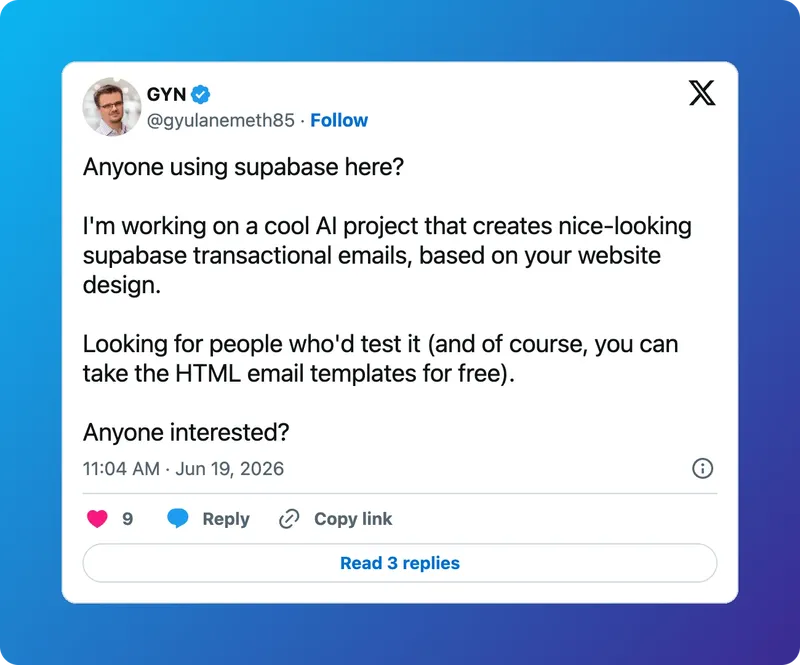
However, social media pages change frequently and automated approaches can break without warning. Content extraction and screenshots are best treated as supplemental options rather than the foundation of the workflow.
Start with RSS. Once that works, add YouTube. Then, when it makes sense, bring in social content as well.
Third-party content does not mean stealing content
Using third-party content as newsletter input does not mean copying entire articles or pretending the content is yours.
That is not the goal.
The goal is curation.
You link to the original source. You mention where the content came from. You summarize it in your own words. You explain why it matters to your audience. In many cases, this is actually good for the original publisher too, because you are sending interested readers back to them.
A good curated newsletter should feel like a guide, not a scraper.
That difference matters.
With the sources figured out, the next question is what the newsletter actually does for your business.
Automated newsletters are useful for lead nurturing
Not everyone who joins your email list is ready to buy. Some people are just learning, some are comparing options. Some are interested, but not urgent for them. Others might have subscribed because the content looked useful.
An automated newsletter gives you a reason to keep showing up without constantly selling.
If every email is a sales email, people stop paying attention. But if the newsletter is genuinely useful, you can stay in touch for months.
Then, when the timing is better, your company is already familiar.
You can still include calls to action, of course.
For example:
- read a related guide
- download a worksheet
- register for a webinar
- try the product
- book a demo
- reply with a question
- check out a new feature
But the main value of the newsletter should be the content. The sales angle should feel like the natural next step, not the whole point.
Personalized newsletters for existing customers
Automated newsletters are not only useful for prospects. They can be even more powerful for existing customers, because you already know something about how those customers behave.
And no, personalization is not about replacing the #first_name# merge tag. Not every subscriber cares about the same topics.
A founder may care about growth. A marketer may care about campaign examples. A developer may care about APIs and technical updates. An existing customer may care about tutorials and product improvements.
So instead of sending the same generic update to everyone, you can curate content based on what people are actually doing.
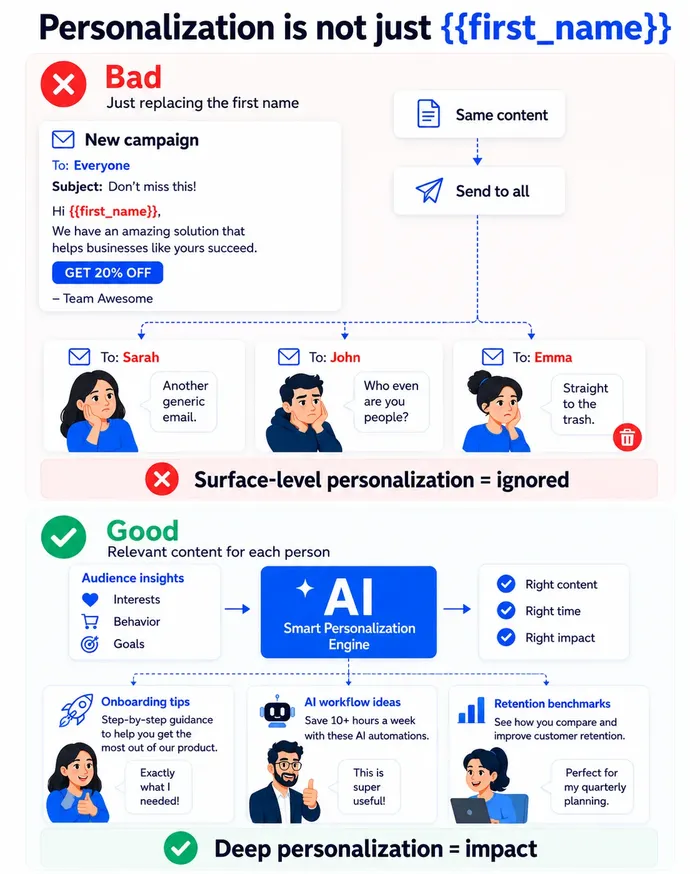
For example, imagine a customer is actively building onboarding sequences. The system could automatically collect and recommend:
- articles about onboarding best practices
- case studies about activation and retention
- videos explaining onboarding strategies
- examples from other companies
- relevant product features related to onboarding
- expert opinions and industry research
A different subscriber interested in AI automation and workflow optimization could receive curated tutorials, case studies, tool updates, and practical examples that match those interests.
So you can change parts of the newsletter based on subscriber interests:
- SaaS subscribers get SaaS examples
- ecommerce subscribers get ecommerce examples
- agencies get client campaign ideas
- developers get technical updates
- customers get product education
The whole newsletter does not need to be different. Even changing one or two content blocks can make the email feel much more relevant. This is where automation, segmentation, and personalization become really useful together.
This becomes even more powerful when you have behavioral data about your customers. When you know which features someone has used, what they have engaged with, or how long they have been a customer, you are not guessing what content will be relevant. You already know.
One important practical note: personalizing content at the individual user level with AI sounds great, but it adds up fast in terms of cost and complexity. A more sustainable approach is to classify your subscribers into a small number of segments, then prepare tailored content for each segment. You get most of the relevance benefit without the overhead of generating a unique newsletter for every single person.
A simple newsletter format works best
The newsletter does not need to be complicated.
Actually, it is usually better if it is simple.
A good structure could look like this:
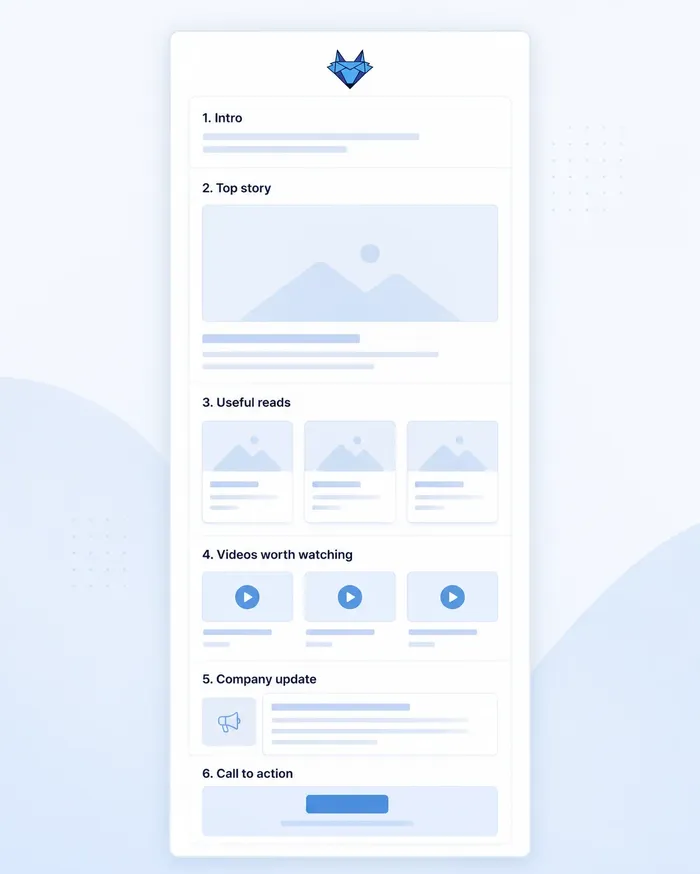
Intro
A short note about what this issue is about.
Top story
The most important item, with a short explanation.
Useful reads
Three to five curated articles.
Videos worth watching
One or two relevant YouTube videos.
Company update
A product update, event, case study, or announcement.
Call to action
One useful next step.
This is only an example, not a template you have to follow exactly.
You can remove sections, add new ones, combine parts, or organize the newsletter differently depending on your audience and goals. Some newsletters may focus almost entirely on curated content. Others may be mostly product updates, educational content, or industry news.
The important thing is not the exact structure. It is making the newsletter easy to scan and useful to read. The reader should be able to quickly understand what is included and decide what they want to open.
A newsletter that feels like homework will not work.
What to avoid with AI-powered newsletters
Automated newsletters can be useful, but they can also become bad very quickly.
Here are the main things to avoid.
Do not send too much
Just because you can send more often does not mean you should. Frequency without quality trains subscribers to ignore you. If the newsletter starts to feel like a regular interruption rather than something worth opening, people stop paying attention or unsubscribe. A weekly or biweekly cadence is usually enough to stay visible without wearing out your welcome. Consistency matters more than volume.
Do not include too many links
Five good links are better than twenty random ones. Filtering is the core skill: the goal is not to send everything the system finds, but to cut down to what is worth this specific subscriber's attention. A newsletter with three well-chosen pieces, each with a clear reason to read them, is more valuable than a digest of twenty links with no context. For each item, include a short explanation of why it matters to the reader: what the article argues, why the timing is relevant, what they will get out of watching the video. That context is what turns a link into a recommendation. AI is especially useful here: it can summarize and cut, not just add more.
Do not trust AI blindly
AI can summarize badly, miss context, or make everything sound the same. The more responsibility you want to give the AI, the more testing, monitoring, and fine-tuning you will need. Over time, maintaining a highly automated newsletter system can start to feel a lot like product development, with ongoing adjustments to sources, prompts, rules, and quality controls.
Do not use low-quality sources
The newsletter is only as good as the sources behind it.
Do not ignore deliverability
Spam filters can block you before you ever reach the inbox, and AI-powered email summaries are adding another layer between your message and the reader's attention. Neither obstacle matters much if your subscribers genuinely want to hear from you. People who look forward to your newsletter move it out of the promotions tab and add you to their contacts. But if the content is weak, these filters will work against you. Stay useful, and deliverability takes care of itself. For a deeper look at how SPF, DKIM, and DMARC affect inbox placement, this article explains it with real examples.
Do not ignore performance data
Open rates and click rates tell you whether the newsletter is actually working. If engagement drops, that is a signal something needs to change: the sources, the summaries, the frequency, or the format. A fully automated system can drift in quality without anyone noticing unless someone is watching the numbers. BlueFox Email's analytics dashboard tracks opens, clicks, and engagement over time so you can catch issues early.
Do not remove your own opinion completely
Curation is useful, but your audience also wants to know what you think. Why does this matter? What should they notice? What is the practical takeaway?
That said, this is not a strict rule. In some cases, adding commentary makes the newsletter more valuable because it provides context and perspective. In other cases, a fully automated digest that simply surfaces relevant updates may be exactly what the audience wants.
The key is to match the level of automation and editorial input to the purpose of the newsletter and the expectations of the readers.
The real value of an AI-powered newsletter
The real value of an AI-powered newsletter is not that it finds more content. It is that it finds less.
Less noise. Less filler. Less clickbait. Less time wasted on headlines that overpromise and articles that underdeliver. AI can extract the key points and present them as concise, information-dense summaries. The result is less hype and more substance.
That is what makes a curated newsletter worth reading. Not the number of links, but the quality of the filter.
Done consistently, that is also how a company earns something hard to copy: the position of trusted filter for its audience. An owned channel, not a borrowed one.
Start building AI-powered newsletters
BlueFox Email is built for this kind of workflow. Design, automate, and send branded newsletters that keep your audience engaged, without unnecessary complexity.
 Gyula Németh · Updated August 5, 2026