
Appearance
Per-contact vs per-send pricing: what an alumni database really costs
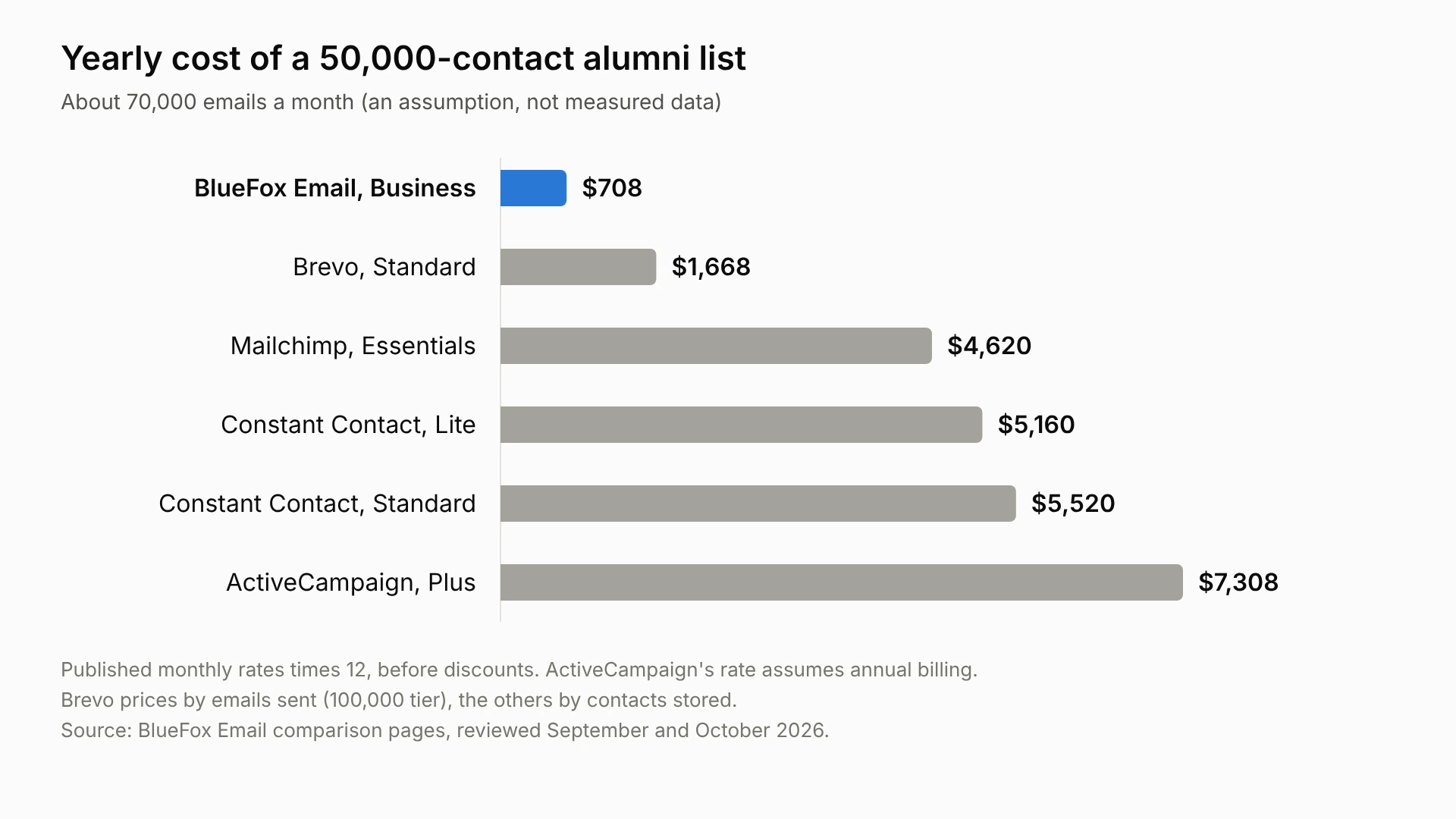
The short answer: for 50,000 mailable alumni contacts and an assumed 70,000 sends a month, BlueFox Email costs $708 a year. The same list costs $4,620 on Mailchimp Essentials, $5,160 to $5,520 on Constant Contact and $7,308 on ActiveCampaign Plus, all of which bill by contacts stored. Brevo bills by emails sent, like BlueFox Email, and costs $984 on Starter or $1,668 on Standard, so part of the gap is the billing model and part is simply a lower price per send.
Every price here was checked on the vendor's own pricing page, from a US location, on November 15, 2026, in USD. BlueFox Email prices exclude VAT, and competitor prices are shown as each vendor lists them, so local VAT treatment may differ.
Per-contact pricing is a bad deal for alumni offices. Not a little bad. Structurally bad.
Here's the number that makes the case. Take 200,000 mailable contacts emailed four times a year: $600 on BlueFox Email, $19,200 on Mailchimp Premium. Same list, same four emails. The full breakdown is further down.
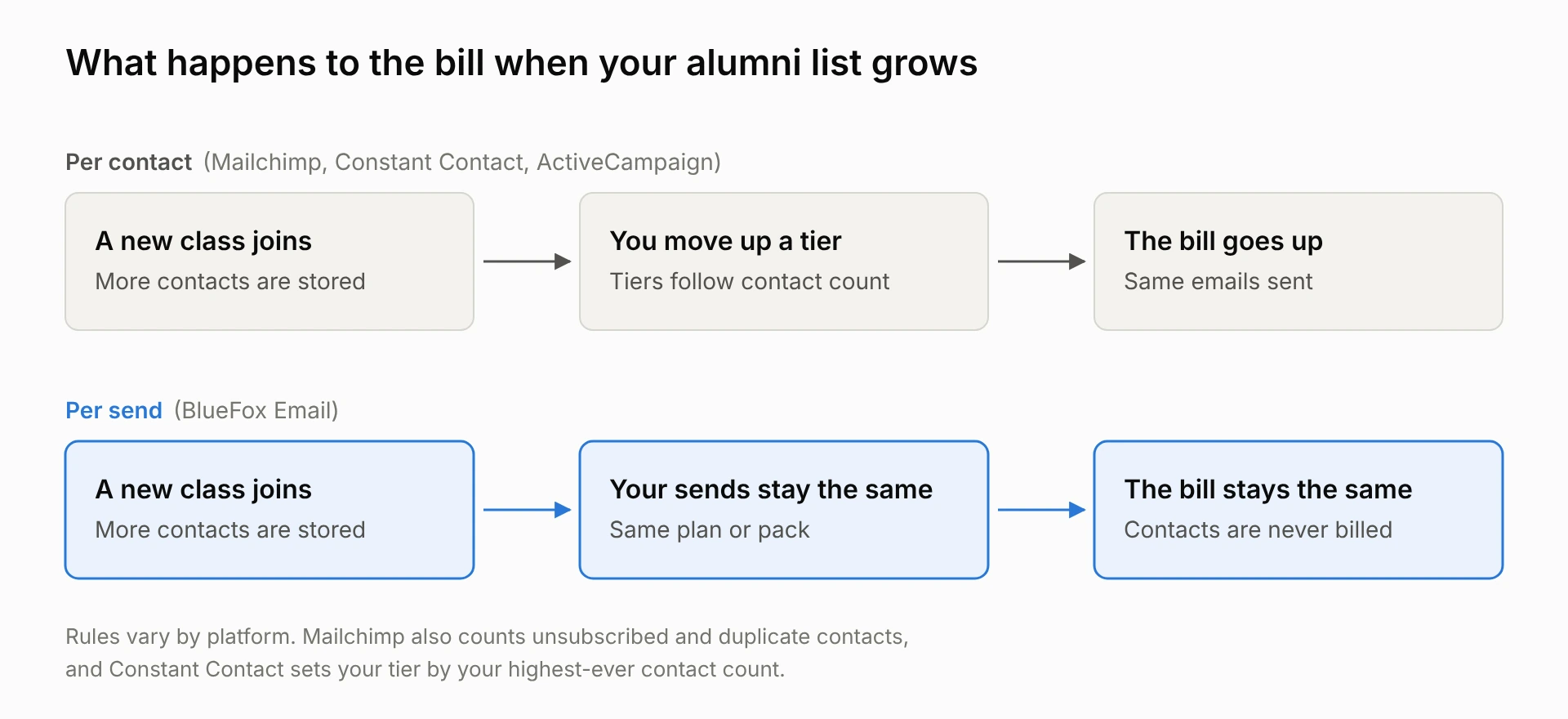
Your list grows every spring when a new class graduates, and almost nobody unsubscribes. They just stop opening. On a per-contact platform you pay for every one of those dormant addresses, every month, whether you email them or not. Mailchimp even counts the people who did unsubscribe, until you archive them. Constant Contact sets your tier by the most active contacts you've ever had, so cleaning the list up later doesn't automatically bring the price down.
Meanwhile, the actual sending is light: a monthly newsletter, a few event invites, a giving appeal in December. Big list, quiet sending. That's exactly the shape per-contact pricing punishes.
Per-send pricing flips it. Storing a contact costs nothing, and the bill tracks only the emails that go out. So I priced it out. I took 50,000 mailable alumni contacts, checked every vendor's own pricing page on November 9, 2026, and ran the numbers. (Three of the four sites tried to show me Canadian dollars first. Pricing pages are a sport.)
The scenario
My assumption: an alumni relations office with 50,000 mailable alumni contacts, sending about 70,000 emails a month. That's a monthly newsletter to the full list, plus segmented event invites and the odd giving appeal. The 70,000 isn't from BlueFox Email usage data. It's a reasonable middle case, so plug in your own number.
"Mailable" matters. A university might hold 50,000 records in its CRM and a much smaller newsletter list. Price the records you would actually keep in the email platform, not the CRM total.
On BlueFox Email, 70,000 sends a month needs the Business plan, $59 a month for 100,000 sends included. The plan one tier down, Pro at $35 a month, only covers 50,000 sends, which falls short here. Over a year, $59 x 12 comes to $708.
How a per-send platform picks a plan
There is no contact limit to check first. The only question is how many emails you will actually send this month, which for a per-send platform is also the only number that changes the bill.
Side by side: the same 50,000 mailable contacts, a year of sending
Same list, same sending, a year on each platform's published prices. Each platform links to its own pricing page.
| Platform | Monthly | Yearly | What BlueFox Email Business saves |
|---|---|---|---|
| BlueFox Email (Business) | $59 | $708 | baseline |
| Mailchimp (Essentials) | $385 | $4,620 | 85% |
| Constant Contact (Lite) | $430 | $5,160 | 86% |
| Constant Contact (Standard) | $460 | $5,520 | 87% |
| ActiveCampaign (Plus) | $609* | $7,308 | 90% |
| Brevo (Starter) | $82 | $984 | 28% |
| Brevo (Standard) | $139 | $1,668 | 58% |
* ActiveCampaign's $609 is a monthly equivalent, billed annually.
The same year on one-time packs
The BlueFox Email figures above use the monthly Business plan. On one-time send packs the same 840,000 sends cost $600 a year, and months where you send nothing cost nothing. The comparison is in Packs and the academic calendar.
A few numbers need context.
Mailchimp's $385 a month is its published Essentials price at 50,000 contacts. It counts unsubscribed contacts the same as active ones while they stay unarchived, so opted-out alumni keep adding to that number until you archive them. Archived contacts are excluded from the current contact total and can lower future bills, so a cleanup does help. It just isn't automatic, and archiving won't lower a peak total already recorded for the current billing period, only future ones. New accounts at 10,000+ contacts get 15% off for the first 12 months ($327.25 a month), which brings year one down to $3,927. Full breakdown in our Mailchimp comparison.
Constant Contact's $430 and $460 are the published rates for the 45,001 to 50,000 contact band. That's the last band before it switches to a sales quote (Constant Contact comparison).
ActiveCampaign's $609 is a monthly equivalent, billed annually, at 50,000 contacts, which is also its last published tier. There is no published monthly-billing price. Accounts opened on or after November 3, 2025 are billed for every stored contact, including unsubscribed and bounced ones (ActiveCampaign comparison).
These are the cheapest tiers on each platform that hold this list and volume, not feature-matched ones. Mailchimp Essentials, Constant Contact Lite, ActiveCampaign Plus and Brevo Starter each leave out different automation, segmentation and testing features. Brevo Standard is in the table because it adds A/B testing and unlimited automation contacts, which Starter doesn't have. Starter also keeps the Brevo logo in your emails unless you add logo removal at $12 a month, which would make it $1,128 a year. BlueFox Email includes every feature on every pack and plan. So if anything, the table flatters the others: matching features means moving up a tier, and that only pushes their price higher.
Brevo is the interesting one. It prices by emails sent, just like BlueFox Email, which makes it the fair test: is BlueFox Email cheaper because of the billing model, or just cheaper? At 70,000 sends a month, Brevo needs its 100,000-email tier: $82 a month on Starter, $139 on Standard (worked through in our Brevo comparison). BlueFox Email still comes in 28% lower than Starter and 58% lower than Standard over a year. So the answer is both. Against Brevo, the gap is a lower price per send, and a fairly modest one next to Starter. Against the three contact-based platforms, the billing model does most of the work.
To price your own list, the pricing calculator lets you set a monthly send volume, or a list size and number of sends a year. It compares against Mailchimp, SendGrid and MailerSend, so its competitor figures will not match the table above.
Packs and the academic calendar
A monthly plan assumes you send about the same amount every month. Fine for a retailer. Wrong for a university. Alumni email clusters hard around homecoming, commencement and year-end giving, then goes quiet all summer. A one-time send pack fits that shape better than a subscription, because you buy sends, not months. Pack sends stay valid for 12 months from the day you buy them, packs stack, and the oldest sends are used first. A silent July costs nothing.
There are two pack sizes: Essential is 50,000 sends for $50, and Premium is 500,000 sends for $300. That puts Premium at $0.60 per 1,000 sends.
| Same year of sending | Monthly plan | One-time packs |
|---|---|---|
| 70,000 a month, 840,000 sends in the year | Business, $708 | 2 Premium packs, $600 (160,000 sends left over) |
| Seasonal: 500,000 sends in the year, 100,000 in the busiest month, nothing in the summer | Business, $708 | 1 Premium pack, $300 |
The second row is an assumed calendar, not BlueFox Email usage data: 80,000 sends in September, 100,000 for homecoming in October, 70,000 in November, 100,000 for the December appeal, and 50,000 each in February, March and April. The busiest month decides which plan you need, and the plan bills all twelve months, so five months where nothing goes out still cost $59 each. One Premium pack covers the whole year exactly.
Packs are not always the answer. If you send a big, steady volume every month, a plan can win, because the more of its allowance you use, the better it looks. At 100,000 sends every month, 1,200,000 in the year, Business is still $708, while packs would cost $800 (two Premium and four Essential).
Buy as you go. You don't need both Premium packs on day one. Buy one now and the second when you need it, so the second pack's 12 months start later and the leftover sends don't expire early.
Bringing your own Amazon SES account doubles pack size at the same price. One Premium BYO pack (1,000,000 sends) covers the same 840,000-send year, and the only extra cost is what AWS charges for delivery. At AWS's à la carte rate of $0.10 per 1,000 emails, that's $84 for 840,000 sends, or about $384 for the year, pack plus AWS fees.
One catch. A brand-new AWS SES account, or an account and region with no metered SES activity since June 1, 2025, starts on AWS's SES Essentials rate instead: $0.16 per 1,000 emails for the first 10 million sends a month, effective July 21, 2026. That puts the AWS portion at about $134 for the year and the total closer to $434. AWS lets you switch to à la carte pricing at any time.
BYO SES also has monthly plans. BYO Pro covers 100,000 sends a month for $35, so the same 70,000-send months cost $420 a year in platform fees plus about $84 to AWS. That's about $504 in total, or about $554 at the SES Essentials rate. More than the BYO Premium pack, but some offices prefer a predictable monthly fee. Both BYO options assume the university is comfortable running its own AWS account. Every BYO figure here is a delivery cost. AWS dedicated IP charges, if IT needs one, are separate (see the dedicated IP section below).
Why BYO SES
BYO SES is optional. It mostly matters to IT teams who want the university's sending reputation to live in the institution's own AWS account, not in BlueFox Email's shared infrastructure. More on that in the dedicated IP section below.
A bigger, quieter list
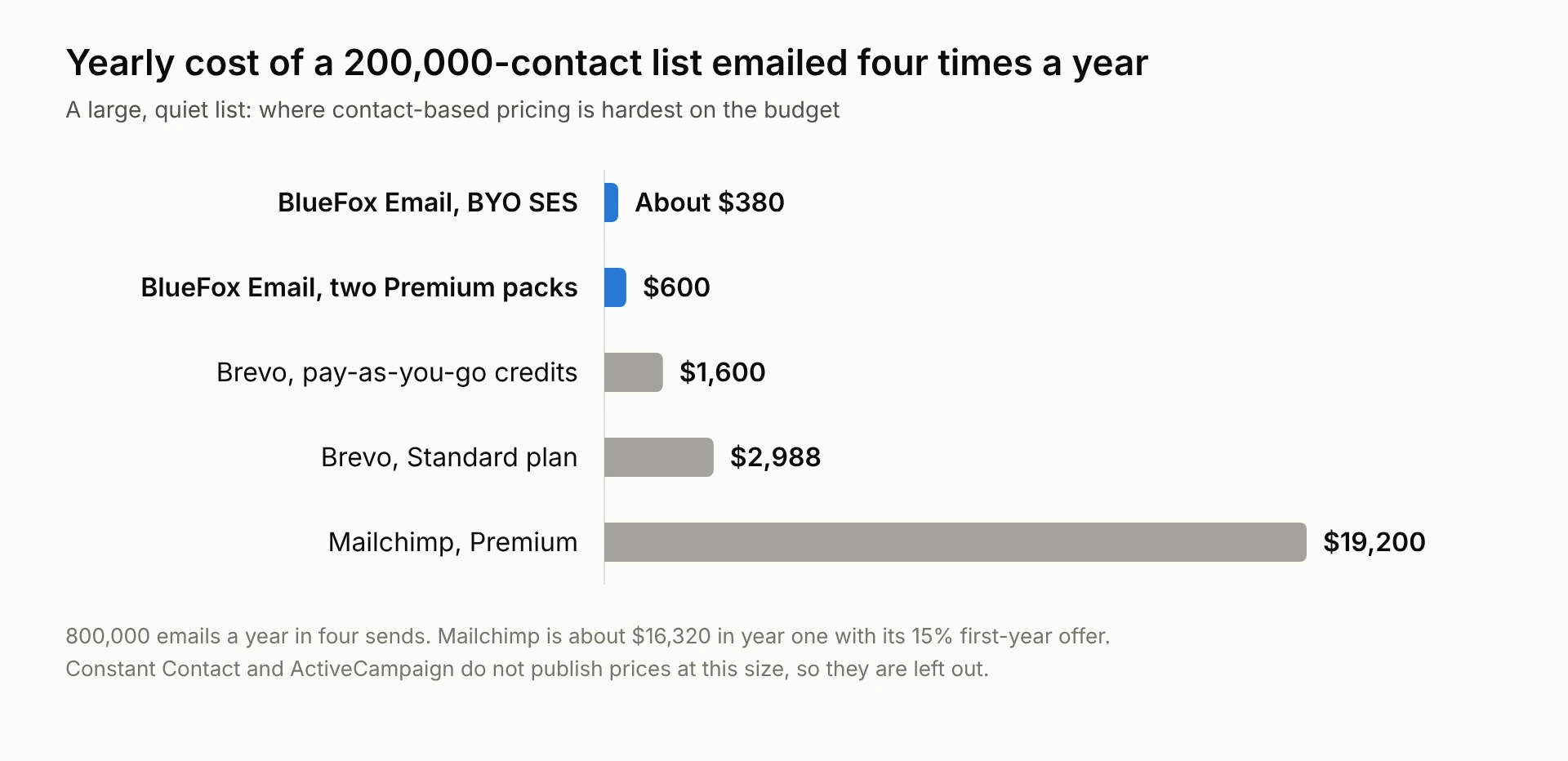
Alumni databases don't stay at 50,000, and the math only gets more lopsided as the list grows and sending slows. Take a larger, older institution: 200,000 contacts and a quarterly update, so four sends a year and 800,000 sends in total. That's close to the worst case for per-contact pricing, because almost the whole bill comes from list size, not activity.
| Platform | Annual cost |
|---|---|
| BlueFox Email (two Premium packs) | $600 |
| BlueFox Email, BYO SES (one Premium pack plus AWS delivery fees; AWS dedicated IP charges are separate) | about $380 at AWS's à la carte rate, about $428 at the SES Essentials rate |
| Mailchimp (Premium, 200,000 contacts) | $19,200/year, billed every month whether a send goes out that month or not (annual plans at this size go through Mailchimp's sales team); about $16,320 in year one with Mailchimp's 15%-off-first-12-months offer at 10,000+ contacts |
| Constant Contact | Not published above 50,000 contacts, so we are not going to guess |
| ActiveCampaign | Not published above 50,000 contacts, so we are not going to guess |
| Brevo (Standard) | One 200,000-email month needs the 250,000-email tier at $249 a month. Brevo bills the plan every month, sending or not, so that's $2,988 a year. Its pay-as-you-go credits are cheaper here and never expire: 800,000 credits fit in the 1,000,000-credit pack, $1,600 as a one-time purchase. |
Mailchimp also sells pay-as-you-go email credits but doesn't publish their prices, so I can't price that route for you.
Notice the pattern. Mailchimp and Brevo's monthly plans both charge for the months when nothing gets sent, because the fee follows a plan tier, not that month's sends. A university mailing four times a year pays for twelve. Two BlueFox Email Premium packs cost $600 whether the 800,000 sends go out in four lumps or spread across the year. That's not BlueFox Email being clever. It's just what happens when you sell sends instead of subscriptions.
What IT will ask: dedicated IPs
Once alumni relations picks a direction, IT usually asks a narrower question: is a dedicated sending IP available, and on what terms? Don't treat it as a formality. The answers vary more than the prices do (background: IP reputation).
| Platform | Dedicated IP | Cost | Minimum to qualify |
|---|---|---|---|
| BlueFox Email | Yes, on request | $50/month | None, available at any volume |
| Mailchimp | Not listed as a feature on any marketing plan | Not published | Not published |
| Constant Contact | Not offered on any self-serve plan | n/a | n/a |
| ActiveCampaign | Yes, but gated | $750 per IP, per ActiveCampaign's help center | 100,000 active, opted-in, engaged contacts |
| Brevo | Yes | $251/year | Professional plan ($499/month and up); included on Enterprise |
ActiveCampaign's gate is the one that bites alumni lists, because it counts engaged contacts, not total contacts. An alumni database can clear 100,000 or even 200,000 names on file while only a much smaller share count as engaged by any platform's definition. So the dedicated IP can stay out of reach even for a big list. BlueFox Email has no contact threshold at all, and Brevo ties it to a plan tier, not an engagement count. Constant Contact doesn't offer one on any self-serve plan, so don't go looking further up its pricing page. On BYO AWS SES, the dedicated IP lives in the university's own AWS account: BlueFox Email charges nothing for it, and AWS bills its own dedicated IP rate.
If IT does require one, here's the annual budget. In the quarterly example above, two hosted Premium packs are $600 and a year-round dedicated IP is another $600 ($50 a month), so $1,200 before VAT. The BYO SES estimates in this post are delivery costs only, with AWS dedicated IP charges on top. AWS lists a standard dedicated IP at $24.95 a month per IP, so about $299 a year for one.
Where other platforms are the better choice
BlueFox Email doesn't win everything an advancement office needs. Here's where it loses.
- A CRM. If advancement needs deal pipelines and lead scoring on the same contact record marketing uses, ActiveCampaign does that through its paid Pipelines add-on, with Sales Engagement as another add-on on top. Neither is in the $609 above. BlueFox Email has no CRM.
- SMS, events and social in one dashboard. Constant Contact includes event registration with payments and social posting on every plan, and sells SMS as an add-on on Lite and Standard in the US and Australia (Premium includes 500 messages). Brevo prices SMS by volume and destination, puts WhatsApp and mobile push on its Professional plan (from $499 a month), and includes web push on lower plans up to a subscriber limit. BlueFox Email sends email only.
- Landing pages. Mailchimp and Brevo's Standard tier both include a builder. BlueFox Email doesn't have one.
- Split tests inside an automation. ActiveCampaign's Pro tier and up supports it, on Plus and Starter its A/B testing is email only. Brevo can split contacts two ways, but more than two branches needs Professional. BlueFox Email's automation branches on conditions such as properties, segments and email activity, not random splits, so there's no A/B split today.
Support is a smaller difference, but a real one. BlueFox Email support is email on every plan, plus the option to book a call with the people building the product. There's no phone line. Constant Contact includes phone support on every paid plan, which is rare in this category. If your team would rather call someone than write a ticket, that might matter more than the price gap.
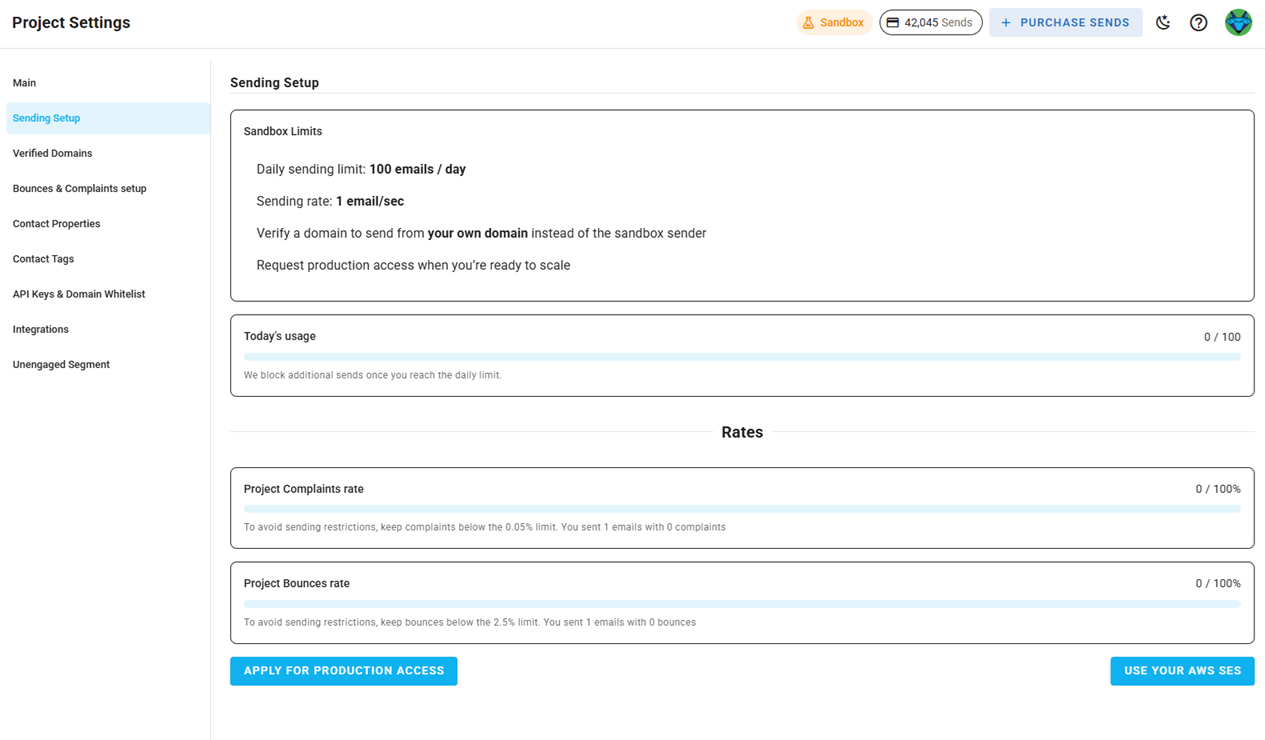
One thing to plan for: every new BlueFox Email project starts in a sandbox, capped at 100 emails a day and one email per second. Before it can move to production and send at its approved volume, it needs a review confirming a verified sending domain (see production mode). That review isn't instant. Get it done well before a hard deadline like the homecoming mailing, not the week of.
If one of those gaps matters more to your office than the price difference, pick something else, or use BlueFox Email for email and another tool for the rest.
How this scenario looks in BlueFox Email
The general setup is in the getting started guide. For a university, three things are worth planning around:
- The IT handoff. Verifying a sending domain means SPF, DKIM, and DMARC records in the institution's DNS, and that's usually where IT gets pulled in. Each project is an isolated workspace with its own domain, contacts, and sending settings, so a university can run one per school or department, or a single one for the whole institution.
- Segmentation. Contacts carry properties such as graduating year, school or program, and degree. Segments filter on those plus engagement history such as opened, clicked, or received, so "Class of 2015, opened an email in the last 90 days" is a single segment rather than a manual export. Importing costs nothing regardless of list size.
- Production-access timing. A new project stays in the sandbox until it's approved, as covered above, so request production access as soon as the domain verifies, not the week of the mailing.
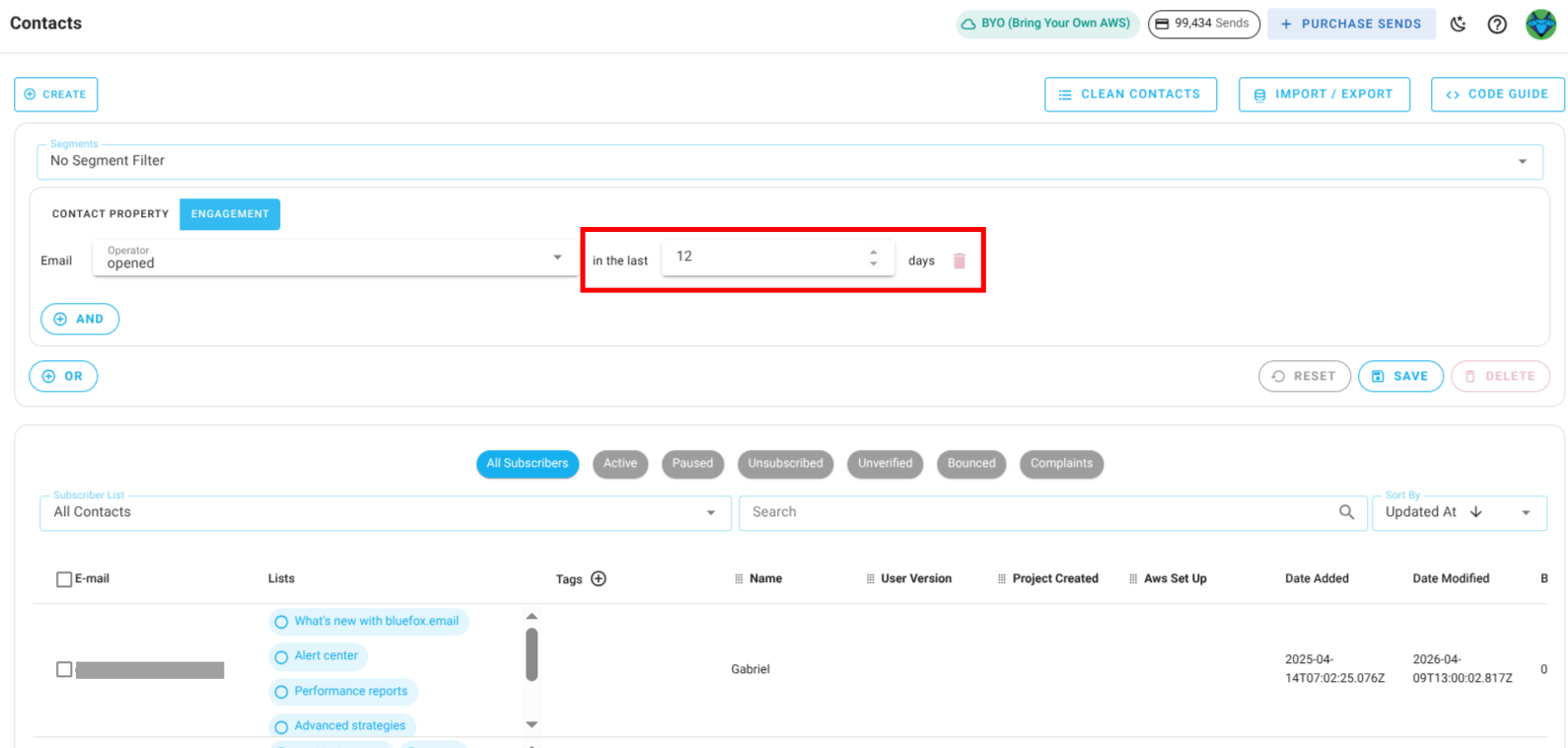
If your team works with an AI assistant, the same steps can be run through BlueFox Email's MCP server, which can import contacts, build segments, and create and schedule campaigns. Review what the agent set up before anything is scheduled.
How to decide
It comes down to two questions. Answer them in this order, before you open a feature list.
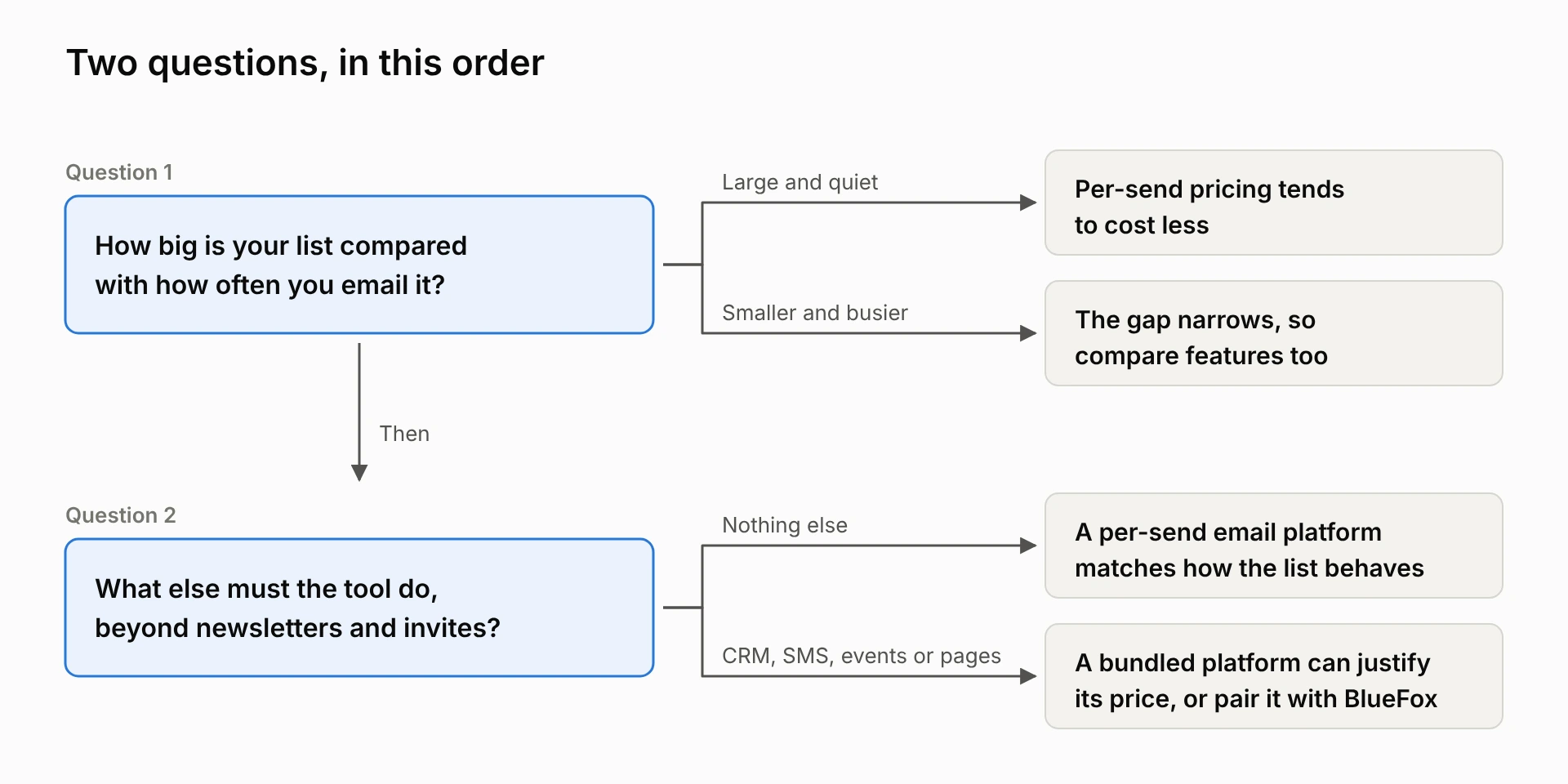
The first is how big the list is compared with how often it gets emailed. The larger and quieter the list, the more a per-contact platform charges for names that barely get mailed, and the further ahead a per-send model pulls. A 200,000-contact list emailed four times a year is near one extreme. A smaller, more engaged list sits closer to the middle, where the gap narrows.
The second is what else the office needs from the same tool today, not what would be nice to have. A CRM, SMS, event ticketing and landing pages have real value if your office uses them now. Paying more for a bundle that replaces several tools can be the right call, even when the email price looks worse on paper. But if the job is newsletters and event invites to a list that keeps growing and rarely shrinks, pay for sends, not names on file. That's the model that matches how an alumni list behaves.
These numbers are one assumed scenario. Run your own list size and sending frequency through them. Current pricing, the comparison pages linked throughout this post, and the BlueFox Email for Universities page use the same public figures cited here and are kept current as platforms change their pricing.
Want to try it first? Start free with 3,000 sends included, no credit card required.
Want your alumni list priced out?
Send us your list size and mailing calendar, and we'll price it out.
 Parth Tiwari · Updated November 15, 2026